Solar Flares vs CMEs: Differences, Timing & Earth Effects
A solar flare is a burst of electromagnetic radiation. A coronal mass ejection, or CME, expels solar plasma and magnetic field into space. They can occur together, but one report does not establish the other. Their differences matter when reading a flare class, an arrival forecast or an aurora headline.
Solar flares: radiation and the sunlit atmosphere
During a flare, the Sun releases additional radiation across the electromagnetic spectrum. X-rays and extreme ultraviolet radiation can change ionization in Earth’s sunlit upper atmosphere, affecting high-frequency radio propagation. The flare’s radiation travels at the speed of light, reaching Earth in about eight minutes.
Flare classes such as C, M and X describe measured X-ray flux. They do not specify the direction or speed of an ejected cloud. An X-class flare is therefore not, by itself, a forecast that a CME will strike Earth or that aurora will be visible from a particular city.
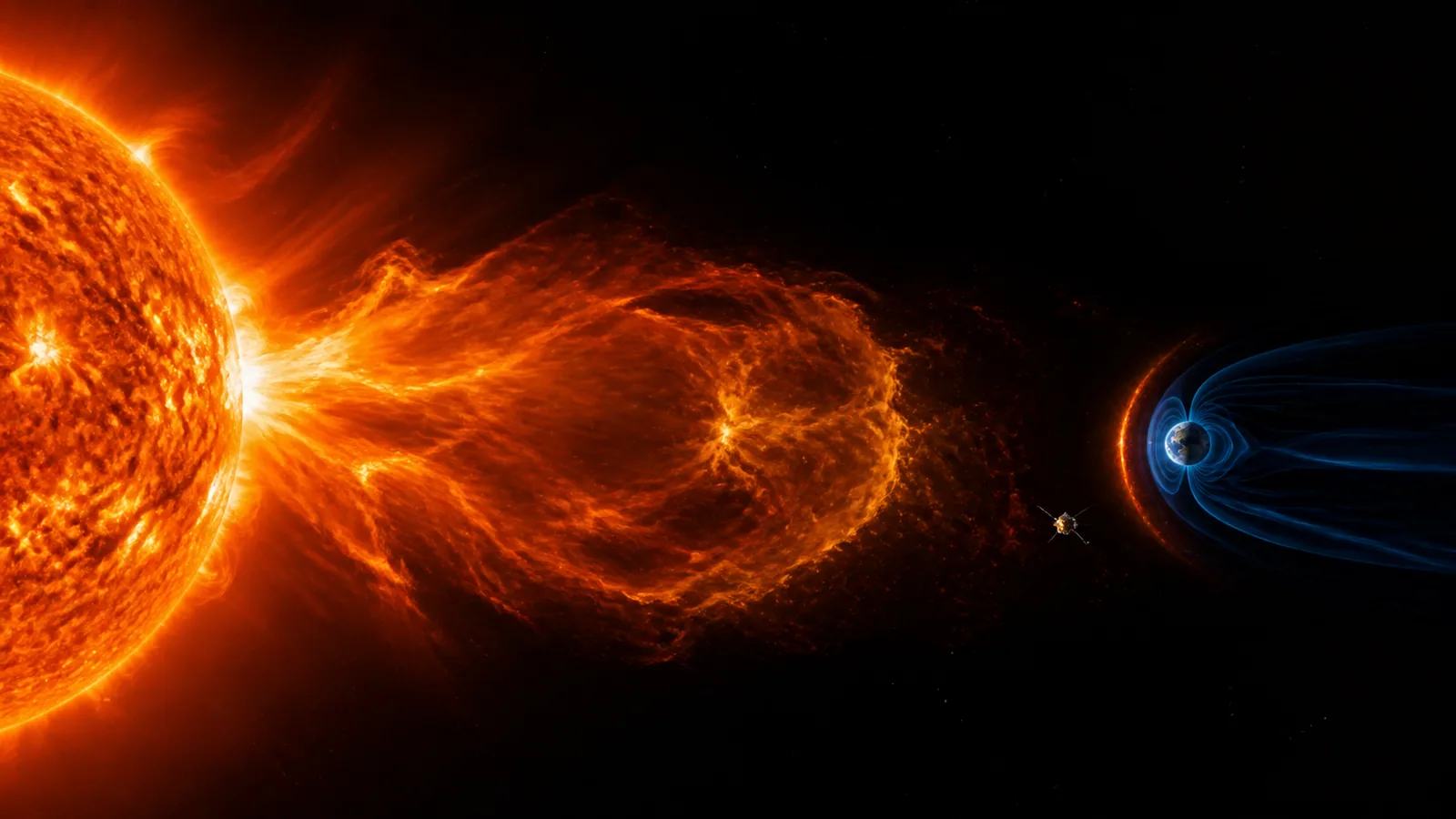
CMEs: moving plasma and magnetic field
A CME carries material and embedded magnetic field outward from the solar corona. Whether it affects Earth depends first on its direction and extent. A dramatic eruption on the Sun can travel away from us.
For an Earth-directed event, travel time depends on speed and evolution through the solar wind. NOAA describes arrivals ranging from roughly 15–18 hours for the fastest events to several days for slower ones. These are broad physical ranges, not a countdown for every eruption. Interaction with Earth’s magnetic environment also depends on the arriving field, including its orientation and duration.
Why the clocks differ
The flare and CME can belong to the same eruption while reaching Earth on different schedules. Light arrives first; the cloud of material follows much later, if it is directed toward Earth. Solar energetic particles are another phenomenon, with their own transport and effects. Avoid combining all three into a single arrival time.
NASA’s explanation of solar storms also distinguishes the radiation burst from the ejected material. This distinction is useful when an early flare report is followed hours later by a revised CME analysis: the later product can answer a question that the flare measurement alone could not.
Read the product before the headline
- Identify the measurement. Is it a flare class, a CME observation, a solar-wind measurement or a geomagnetic index?
- Check its time. Observation time, issue time and forecast arrival window describe different stages.
- Check direction and uncertainty. A detected CME is not automatically an Earth-impact forecast.
- Follow the official update. New imagery, modeling and upstream measurements can refine the assessment.
For exploration, start with solar activity, then compare space-weather conditions and aurora guidance. A source timestamp is as important as the value beside it.
Does a solar flare guarantee aurora?
No. A flare classification alone does not establish an Earth-directed CME, the eventual geomagnetic response or local viewing conditions. Treat aurora visibility as a separate question. PlanetVexa’s explanatory views do not replace official operational advisories.
Primary sources and further reading
- NOAA SWPC: solar flares and radio blackouts
- NOAA SWPC: coronal mass ejections
- NASA: solar storms and flares
Continue with how solar storms reach Earth, the Kp index or earthquake magnitude versus intensity.