How Solar Storms Travel from the Sun to Earth
A flare, energetic particles, solar wind and a coronal mass ejection travel differently. Follow the observation chain without treating every solar eruption as an Earth impact.
Open space-weather observatoryWhat the data really means
Use these four anchors before interpreting the related live visualization.
- Solar flare
- Electromagnetic radiation; reaches Earth in about eight minutes
- Energetic particles
- Fast charged particles; minutes to hours
- CME
- Large plasma and magnetic structure; hours to days
- Geoeffectiveness
- Depends strongly on arrival conditions and magnetic orientation
From evidence to the PlanetVexa view
Each stage changes what can be claimed. PlanetVexa keeps the source record, derived interpretation and visual presentation visibly distinct.
- 01Solar flare
Electromagnetic radiation; reaches Earth in about eight minutes
- 02Energetic particles
Fast charged particles; minutes to hours
- 03CME
Large plasma and magnetic structure; hours to days
- 04Geoeffectiveness
Depends strongly on arrival conditions and magnetic orientation
One eruption can produce several different signals
A solar flare is a burst of electromagnetic radiation generated by magnetic energy release. Its light reaches Earth in roughly eight minutes and can affect the sunlit ionosphere. A coronal mass ejection is a much larger expulsion of plasma and magnetic field that propagates through the solar wind. Energetic particles can arrive on another time scale.
These products can be associated without being identical. A strong flare does not guarantee an Earth-directed CME, and a CME can occur without a conspicuous flare.
Coronagraphs reveal material leaving the Sun
The bright solar disk overwhelms the faint corona, so a coronagraph blocks the disk and images structures expanding outward. Analysts estimate a CME’s direction, speed, width and density from one or more viewpoints, then use models to assess whether it may intersect Earth. Projection makes an eruption aimed toward or away from the observer difficult to measure precisely.
A modeled arrival window is a forecast, not an observation of plasma already at Earth. Several CMEs can interact and change timing.
Upstream monitors provide the final in-situ evidence
Solar-wind observatories near the Sun–Earth L1 region sample plasma density, velocity and the interplanetary magnetic field before conditions reach Earth. This offers a short lead time and a much better view of the magnetic orientation that controls coupling with the magnetosphere. A southward field can favor stronger energy transfer than a similarly fast structure with another orientation.
The upstream spacecraft samples one part of a very large, evolving structure. Its record is not a complete three-dimensional image of the CME.
Earth response is measured, not assumed
When disturbed solar wind interacts with the magnetosphere, ground magnetometers and space instruments observe geomagnetic activity, particles and ionospheric change. NOAA SWPC watches, warnings and alerts use different evidence and lead times. Aurora can expand equatorward during storms, but cloud, daylight and local conditions still determine visibility.
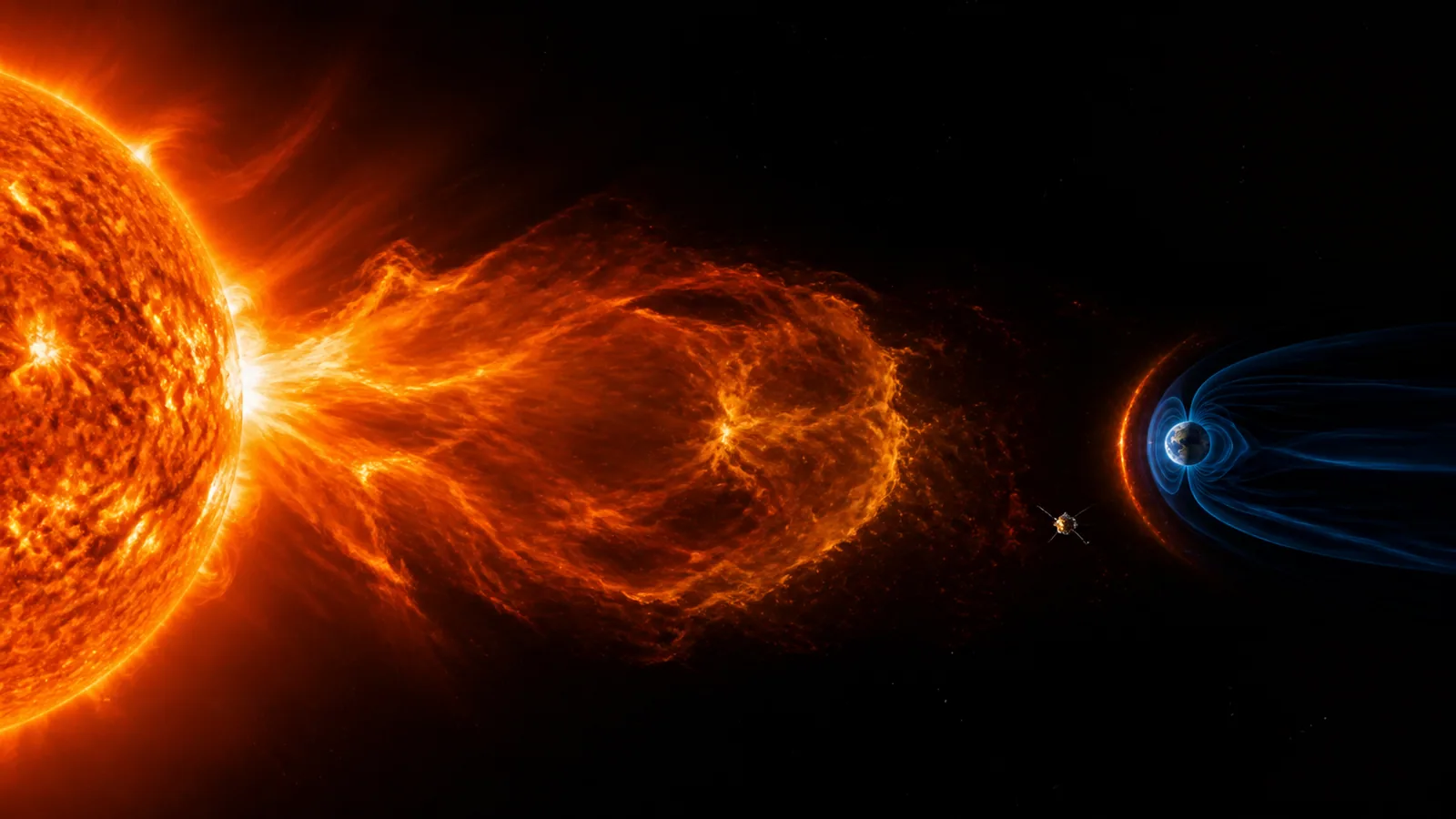
PlanetVexa keeps solar events, modeled propagation, upstream measurements and observed geomagnetic indices as separate layers with their own timestamps. The Sun–Earth scene is explicitly schematic, not to scale.
Questions people ask
Does every solar flare cause a geomagnetic storm?
No. Geomagnetic effects depend on whether a CME or solar-wind structure reaches Earth and on its magnetic conditions.
Why is CME arrival uncertain?
Direction, projection, speed evolution and interactions with the background solar wind or other CMEs affect timing.
Is the Sun–Earth visualization to scale?
No. A true scale would make Earth and the event structure impractical to inspect together; the scene is labeled schematic.
Read the official material
PlanetVexa summarizes these sources in original language and links to the responsible institutions for definitions and operational context.