How Near-Earth Asteroids Are Detected and Tracked
Follow faint telescope detections into astrometry, an evolving orbit solution, close-approach predictions and explicit uncertainty.
Explore near-Earth close approachesWhat the data really means
Use these four anchors before interpreting the related live visualization.
- Discovery
- Repeated moving detections against background stars
- Astrometry
- Measured sky position and observation time
- Orbit solution
- Best fit to all accepted observations
- Close approach
- Predicted geometry with uncertainty
From evidence to the PlanetVexa view
Each stage changes what can be claimed. PlanetVexa keeps the source record, derived interpretation and visual presentation visibly distinct.
- 01Discovery
Repeated moving detections against background stars
- 02Astrometry
Measured sky position and observation time
- 03Orbit solution
Best fit to all accepted observations
- 04Close approach
Predicted geometry with uncertainty
Survey telescopes discover movement in the sky
Wide-field surveys image the same region repeatedly and search for sources that move relative to background stars. A candidate needs follow-up observations to establish that it is a real Solar System object rather than noise, an artifact or a previously known body. Discovery circumstances favor certain directions, brightnesses and observing conditions.
The detected point of light usually does not reveal a resolved rocky surface. Size commonly remains an estimate derived from brightness and an assumed or measured reflectivity.
Astrometry constrains a three-dimensional orbit
Each observation provides time-stamped sky coordinates from a known observatory. A short arc can support many possible distances and velocities, so follow-up over a longer time greatly reduces ambiguity. Radar observations, when geometry permits, can add strong range and velocity constraints.
The orbit is found by adjusting orbital parameters until calculated positions best fit the accepted measurements. Residuals and observation uncertainties remain part of the solution.
New data change the prediction and its uncertainty
JPL CNEOS computes high-precision solutions using complete astrometric sets, weighting, debiasing and models of gravitational forces. The solution is propagated to predict future positions and close approaches. Uncertainty normally grows with time and can shrink sharply when new observations extend the arc.
A changing miss distance after discovery usually reflects improved knowledge, not an asteroid physically changing course. PlanetVexa shows source-updated facts rather than freezing the first estimate.
Close approach does not mean predicted impact
A close-approach table includes many objects passing safely at astronomical distances. Specialized systems such as Sentry test whether trajectories compatible with current uncertainty could intersect Earth. Very small probabilities, uncertainty regions and later removal from a risk table require careful interpretation.
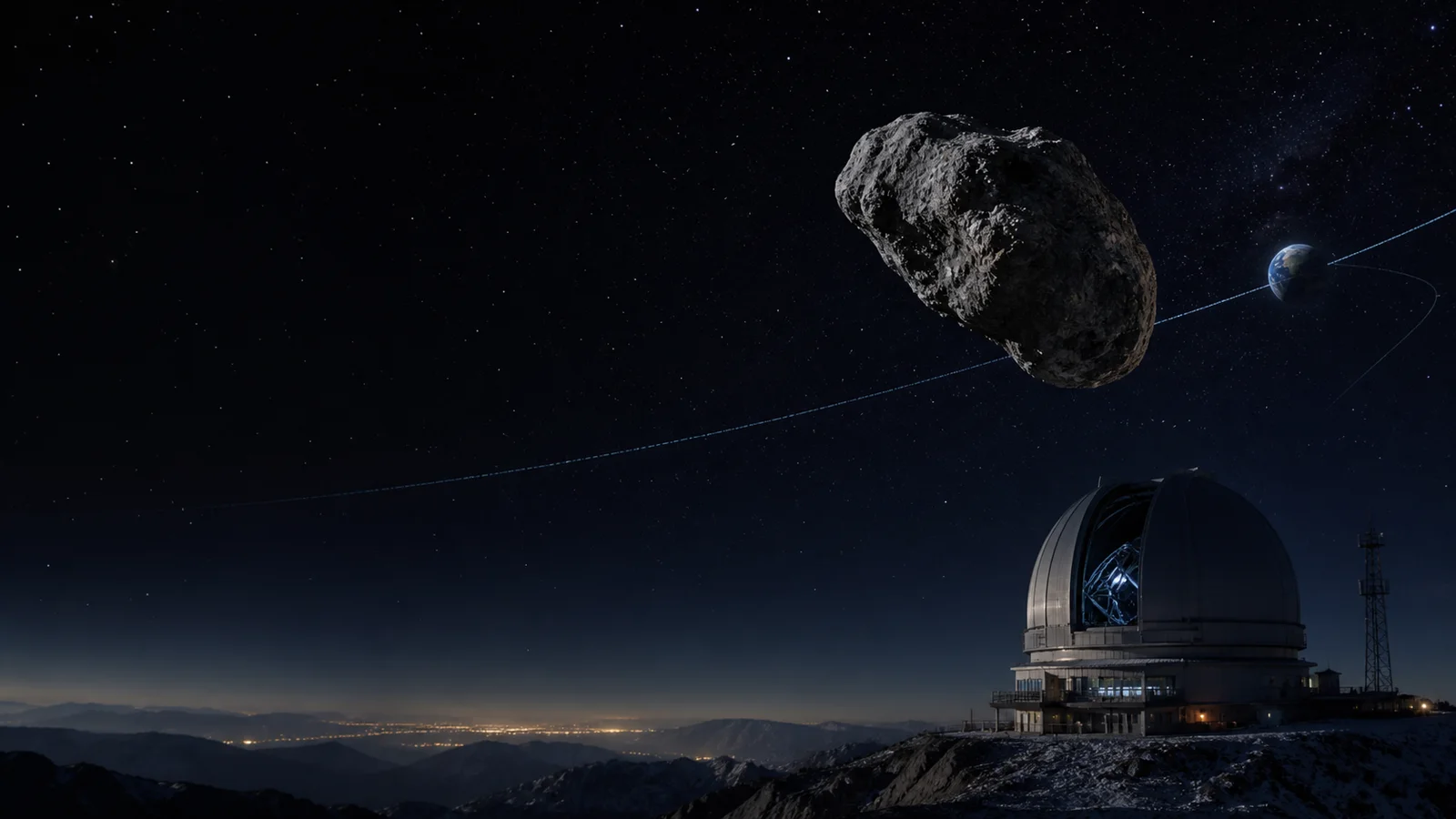
The 3D PlanetVexa scene is schematic: object sizes, orbital separation and event speed are exaggerated for interaction. Numeric distance, epoch and source status carry the scientific meaning.
Questions people ask
Does a close approach mean an asteroid will hit Earth?
No. It is a predicted passage within a defined reporting distance; impact monitoring is a separate uncertainty analysis.
Why does the predicted distance change?
Additional astrometry, radar data and improved weighting refine the orbit and uncertainty.
Is the asteroid shown at true size beside Earth?
No. A true-scale object would usually be invisible; the visual size and spacing are explicitly schematic.
Read the official material
PlanetVexa summarizes these sources in original language and links to the responsible institutions for definitions and operational context.