How Earth’s Magnetosphere Works
Understand the invisible, changing boundary where Earth’s magnetic field meets the solar wind — and what a 3D visualization can and cannot show.
Explore the 3D magnetosphereWhat the data really means
Use these four anchors before interpreting the related live visualization.
- Interior source
- Motion in Earth’s electrically conducting outer core
- External driver
- Solar wind and interplanetary magnetic field
- Dayside shape
- Compressed toward the Sun
- Nightside shape
- Extended into a long magnetotail
From evidence to the PlanetVexa view
Each stage changes what can be claimed. PlanetVexa keeps the source record, derived interpretation and visual presentation visibly distinct.
- 01Interior source
Motion in Earth’s electrically conducting outer core
- 02External driver
Solar wind and interplanetary magnetic field
- 03Dayside shape
Compressed toward the Sun
- 04Nightside shape
Extended into a long magnetotail
A magnetic field becomes a space environment
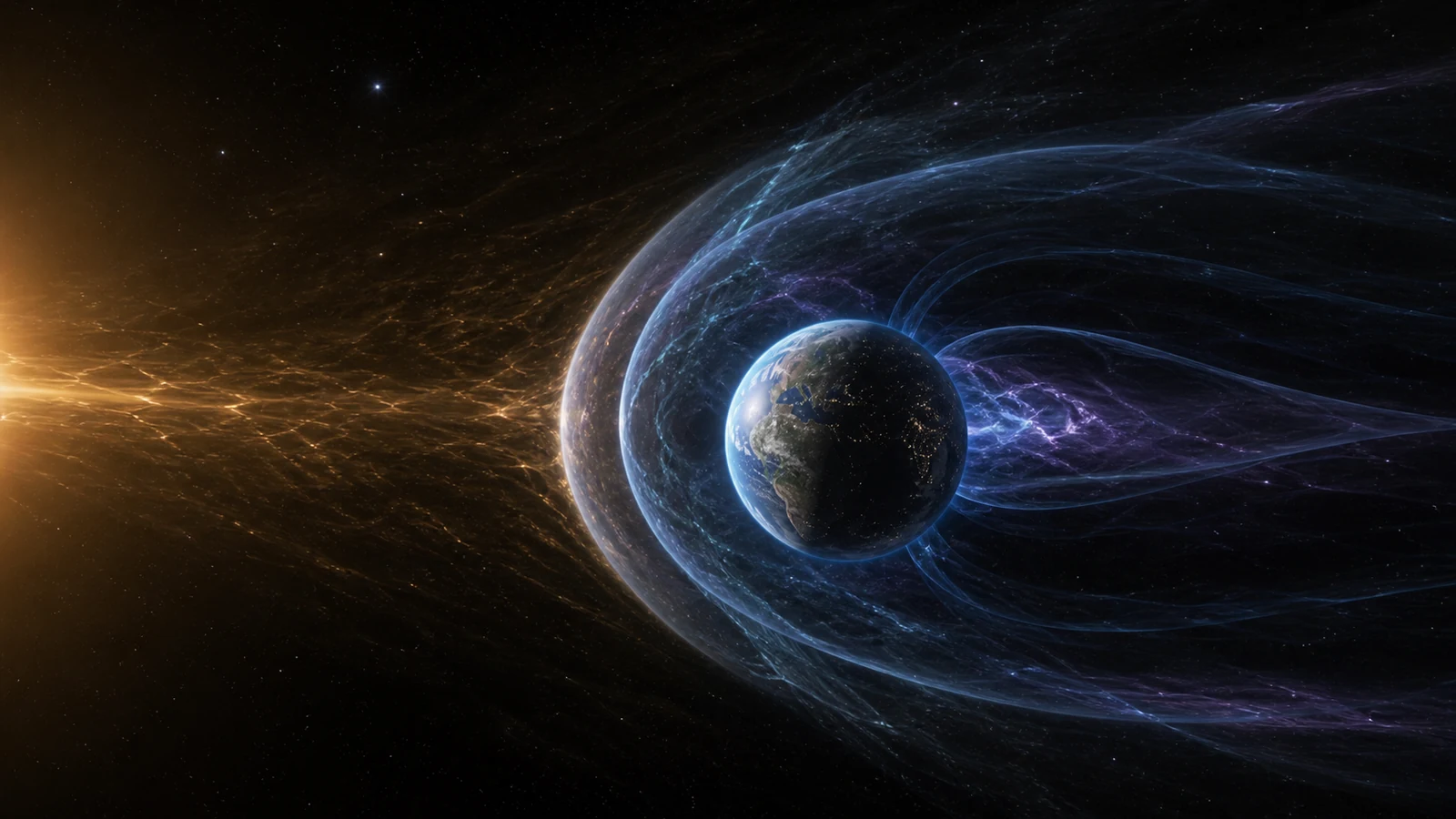
Earth’s magnetic field is generated primarily by motion in its electrically conducting liquid outer core. Far above the atmosphere, that field organizes charged particles and helps define a region where Earth’s magnetic influence dominates over the surrounding solar wind. That region is the magnetosphere. It is not a rigid shell and its field lines are not visible objects.
Spacecraft infer this environment from local measurements of magnetic field, electric field, plasma density, particle energy and direction. A global image is therefore a scientific reconstruction: many measurements and physical models assembled into a coherent view.
The solar wind reshapes the field
The solar wind is a continuous flow of charged particles carrying the Sun’s magnetic field through interplanetary space. Its pressure compresses the Sun-facing side of the magnetosphere. On the nightside, magnetic structures are stretched into the magnetotail, which can extend far beyond the Moon’s orbit.
Boundary position changes with solar-wind pressure and magnetic conditions. A faster wind is not, by itself, a complete measure of geomagnetic impact; density, field strength and especially magnetic orientation also influence how energy couples into near-Earth space.
Boundaries describe transitions, not solid walls
The bow shock slows and heats much of the supersonic solar wind upstream of Earth. The magnetosheath is the disturbed plasma between that shock and the magnetopause. The magnetopause marks a changing pressure balance, while polar cusps create regions where particles can access the upper atmosphere more directly.
These boundaries move and fluctuate. PlanetVexa renders them as translucent surfaces so they can be inspected, but their apparent thickness, brightness and spacing are visual aids rather than measurements of a solid structure.
Reconnection connects space weather to Earth
When solar-wind and terrestrial magnetic fields are favorably oriented, magnetic reconnection can transfer energy into the magnetosphere. Energy stored in the magnetotail can later be released, driving particle acceleration, aurora and electrical currents in the upper atmosphere and near-Earth space.
Kp, IMF Bz and solar-wind values describe different parts of that chain. They should be read with their timestamps and product labels. No single index proves that a specific local effect is occurring, and a schematic scene is not an operational forecast.
Questions people ask
Is the magnetosphere a solid protective shield?
No. It is a dynamic region of magnetic fields and plasma whose boundaries respond continuously to the solar wind.
Are magnetic field lines physically visible?
No. Lines are a visualization convention used to represent field direction and structure inferred from measurements and models.
Does negative IMF Bz always cause a storm?
No. Southward Bz can favor coupling, but duration, field strength, solar-wind conditions and Earth’s response all matter.
Read the official material
PlanetVexa summarizes these sources in original language and links to the responsible institutions for definitions and operational context.