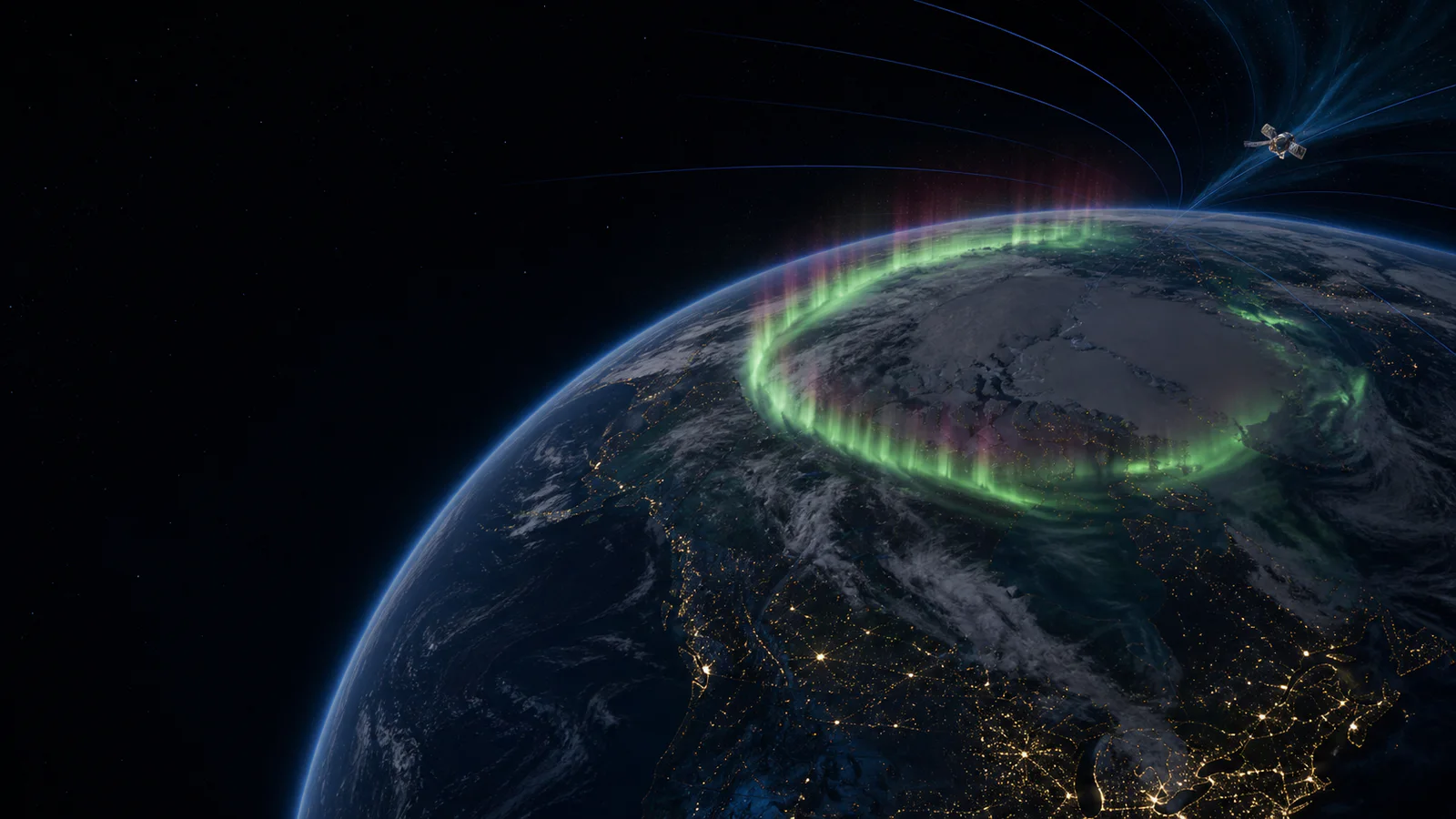
How Aurora Forecasts Work
Follow solar-wind measurements into an auroral-oval model, then separate predicted energy input from darkness, cloud and actual visibility.
Explore the aurora forecastWhat the data really means
Use these four anchors before interpreting the related live visualization.
- Upstream input
- Solar wind and interplanetary magnetic field
- Model output
- Estimated auroral energy or viewing probability
- Oval motion
- Expands and shifts with geomagnetic activity
- Ground visibility
- Also requires darkness, clear sky and favorable location
From evidence to the PlanetVexa view
Each stage changes what can be claimed. PlanetVexa keeps the source record, derived interpretation and visual presentation visibly distinct.
- 01Upstream input
Solar wind and interplanetary magnetic field
- 02Model output
Estimated auroral energy or viewing probability
- 03Oval motion
Expands and shifts with geomagnetic activity
- 04Ground visibility
Also requires darkness, clear sky and favorable location
Aurora begins with particles and the upper atmosphere
Energy transferred from the solar wind into Earth’s magnetosphere accelerates charged particles toward high latitudes. Collisions with oxygen and nitrogen in the upper atmosphere produce light at characteristic colors and altitudes. The aurora is an atmospheric emission, not a ring floating far above Earth.
Its structure changes rapidly in arcs, curtains and diffuse regions. A global map necessarily summarizes detail that a local observer may see differently.
Upstream measurements support a short-range model
Spacecraft near the Sun–Earth L1 region measure solar-wind speed, density and the interplanetary magnetic field before conditions reach Earth. Models such as OVATION use current and recent inputs to estimate where auroral energy is likely in the northern and southern ovals.
The spacecraft samples one part of an evolving solar-wind structure, and propagation time is approximate. The model is a forecast or nowcast, not a direct all-sky photograph.
The colored oval represents probability or energy
Auroral products may express estimated energy flux, intensity or probability of observing aurora under ideal conditions. The oval commonly expands equatorward and becomes more active during geomagnetic disturbance, but local substorms can brighten or move structures within the broader pattern.
A color scale must retain its product definition and valid time. It should not be translated into a guaranteed sighting.
Space weather is only half of ground visibility
An observer also needs astronomical darkness, a clear view toward the relevant horizon, limited cloud and low light pollution. Moonlight, terrain and camera sensitivity change what is visible or photographable. High latitude does not guarantee clear sky, and a strong forecast during daylight cannot be seen from the ground.
PlanetVexa combines the source forecast with Earth orientation and explanatory context. It does not infer local cloud-free visibility or replace NOAA SWPC products and local weather forecasts.
Questions people ask
Does a bright auroral oval guarantee I will see aurora?
No. Darkness, cloud, light pollution, horizon, location and timing remain essential.
Is the forecast oval a photograph?
No. It is a model estimate driven by solar-wind and geomagnetic information.
Why does the aurora move while Kp stays the same?
Kp is a three-hour planetary index; local auroral structures can evolve much faster.
Read the official material
PlanetVexa summarizes these sources in original language and links to the responsible institutions for definitions and operational context.