What Is the Kp Index?
Understand the 0–9 planetary index used to summarize geomagnetic activity and its relationship to aurora and NOAA storm scales.
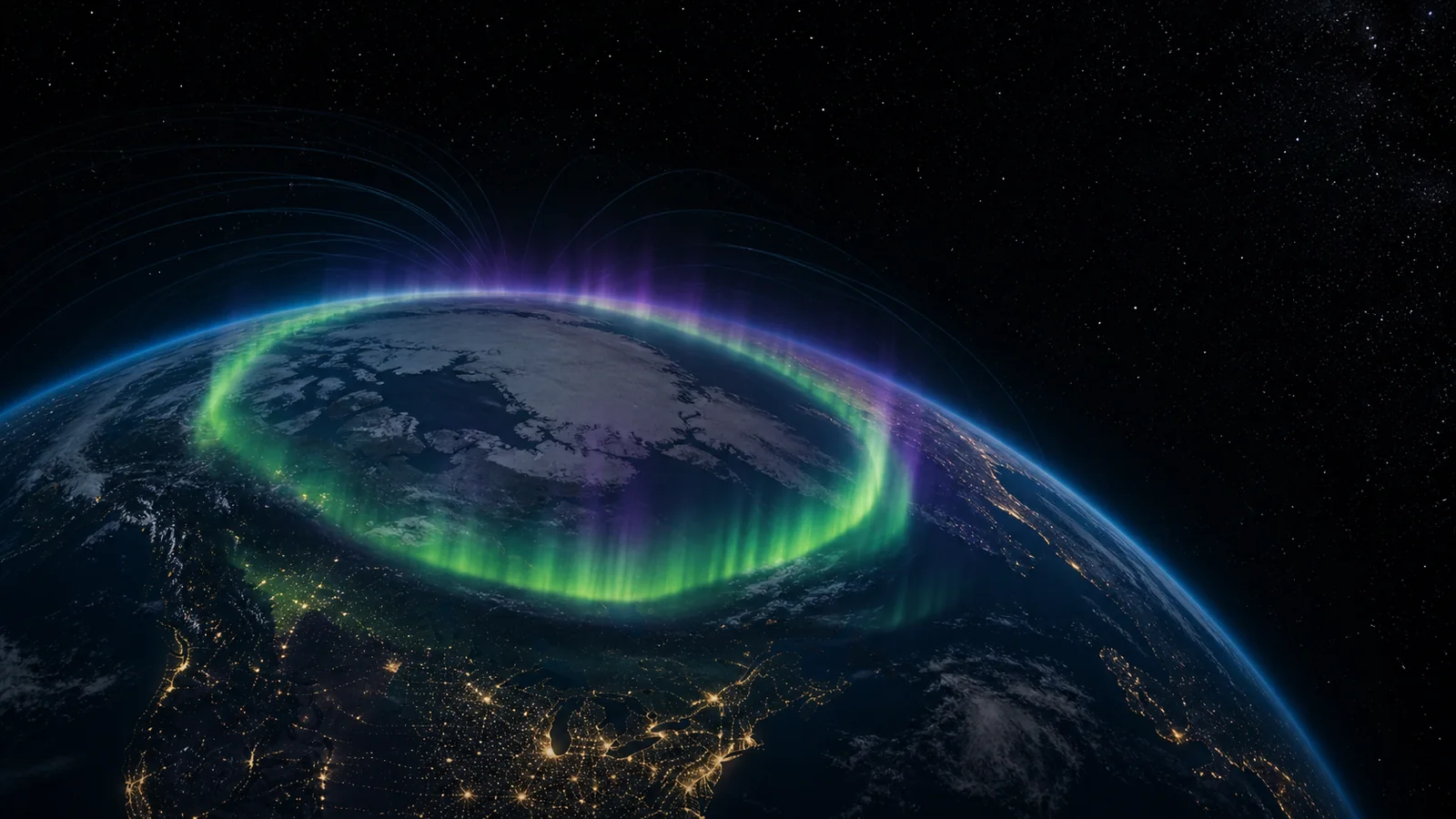
Scientific editorial reconstruction. The auroral oval is illustrative and must not be read as the current OVATION forecast boundary.
A 0–9 summary of geomagnetic activity
Kp combines standardized measurements from mid-latitude magnetometers into a planetary index. Values near 0 describe quiet conditions; higher values describe increasingly disturbed geomagnetic conditions. Kp 5 or greater corresponds to the start of NOAA’s G-scale geomagnetic-storm levels.
Useful context, not a local guarantee
Higher Kp can support aurora visibility at lower geomagnetic latitudes, but cloud, daylight, light pollution, local magnetic latitude and the timing of the disturbance still matter. Kp does not describe every local magnetic fluctuation and is not a direct forecast of impacts to a particular grid, satellite or radio link.
From evidence to the PlanetVexa view
Each stage changes what can be claimed. PlanetVexa keeps the source record, derived interpretation and visual presentation visibly distinct.
- 01Ground magnetometers
A distributed station network measures local magnetic disturbance.
- 02K values
Each station converts disturbance into a quasi-logarithmic local K index.
- 03Planetary Kp
Selected station values are standardized and combined into a three-hour planetary index.
- 04PlanetVexa record
Observed, estimated and forecast products retain their status, timestamp and NOAA attribution.
Use Kp as global context
First distinguish observed, estimated and forecast Kp. Then compare it with solar-wind conditions, NOAA storm scales and the valid time of an aurora product.
Higher Kp can support aurora farther from the pole, but it cannot answer whether one location is dark, cloud-free or inside a current auroral structure.
Current Kp Index
Live records refresh independently from this article. Source time and freshness never change the editorial “Last updated” date above.
Source: NOAA Space Weather Prediction Center · Freshness: Fresh · Live data updated · source details
Explore Space WeatherUse source time, definitions and official guidance
PlanetVexa explains and normalizes source-backed information for general understanding. Values can be revised, observations can be incomplete, and a global or statistical measure cannot replace local analysis or official safety guidance.
FAQ
Is Kp observed or forecast?
Kp products can be observed, estimated or forecast. PlanetVexa labels the connected record’s status and timestamp.
Does high Kp guarantee visible aurora?
No. Location, darkness, cloud and the timing of the disturbance remain decisive.
Read the official material
Definitions and operational context are checked against the responsible institutions. External material can be revised independently of PlanetVexa.