Hurricane Categories Explained
Read Categories 1–5 as a wind classification while keeping storm surge, rainfall, size and local vulnerability in view.
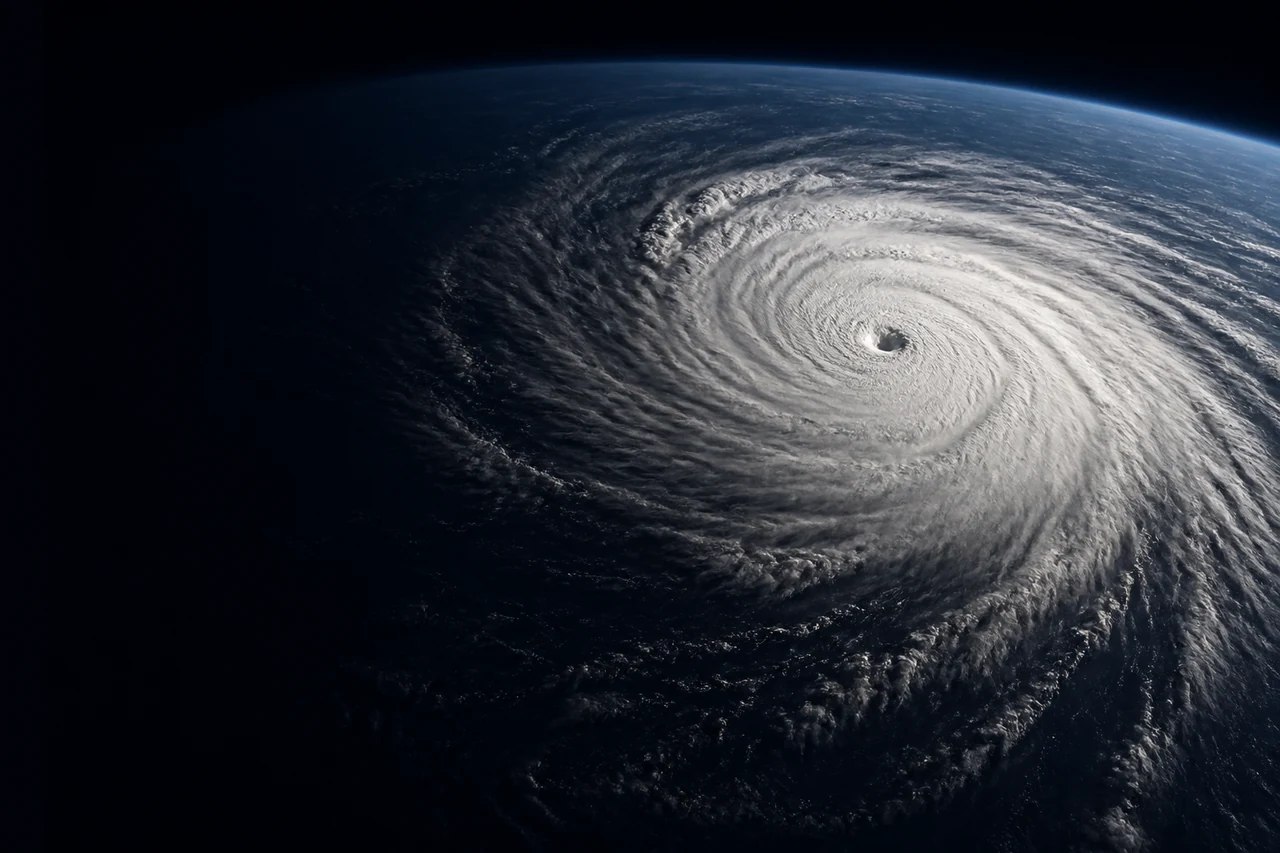
Illustrative orbital view. Category is determined from the official maximum sustained wind, not from the apparent size or symmetry of cloud in an image.
Categories classify sustained wind
The Saffir–Simpson Hurricane Wind Scale assigns Category 1 through 5 using the cyclone’s maximum sustained wind. Category 1 begins at 74 mph (119 km/h); Category 2 at 96 mph; Category 3 at 111 mph; Category 4 at 130 mph; and Category 5 at 157 mph.
Category 3–5 storms are called major hurricanes because of wind potential, but a lower-category system can still be life-threatening.
Wind category is not total storm risk
The category does not directly measure storm surge, rainfall, flooding, tornadoes, storm size, forward speed or how long hazardous conditions persist. Central pressure supports meteorological interpretation but does not determine the category by itself. Always use the official forecast, watches, warnings and local emergency guidance.
From evidence to the PlanetVexa view
Each stage changes what can be claimed. PlanetVexa keeps the source record, derived interpretation and visual presentation visibly distinct.
- 01Observation
Aircraft, satellite, radar, buoy and surface reports help analysts assess the cyclone.
- 02Analysis
The responsible center estimates position, structure and maximum sustained wind.
- 03Wind category
The Saffir–Simpson category uses maximum sustained wind only.
- 04PlanetVexa record
Track, advisory time, wind, category and official source are displayed without inventing other hazards.
Read category beside the advisory
Check whether the value is an observation, analysis or forecast and note the advisory issue time. A category can change while the broader rainfall or surge threat remains severe.
Use PlanetVexa to compare active systems and open the source-backed record, then rely on official watches, warnings and local emergency guidance for protective action.
Active Tropical Systems
Live records refresh independently from this article. Source time and freshness never change the editorial “Last updated” date above.
Source: NOAA National Hurricane Center · Freshness: Fresh · Live data updated · source details
Explore Active HurricanesUse source time, definitions and official guidance
PlanetVexa explains and normalizes source-backed information for general understanding. Values can be revised, observations can be incomplete, and a global or statistical measure cannot replace local analysis or official safety guidance.
FAQ
Does a category include storm surge?
No. The Saffir–Simpson category is based on maximum sustained wind.
Can a Category 1 hurricane be dangerous?
Yes. Flooding, surge, tornadoes and local vulnerability can create severe impacts at any category.
Read the official material
Definitions and operational context are checked against the responsible institutions. External material can be revised independently of PlanetVexa.