What Is Earthquake Magnitude?
Understand what magnitude measures, why the scale is logarithmic and why depth, distance and local conditions still matter.
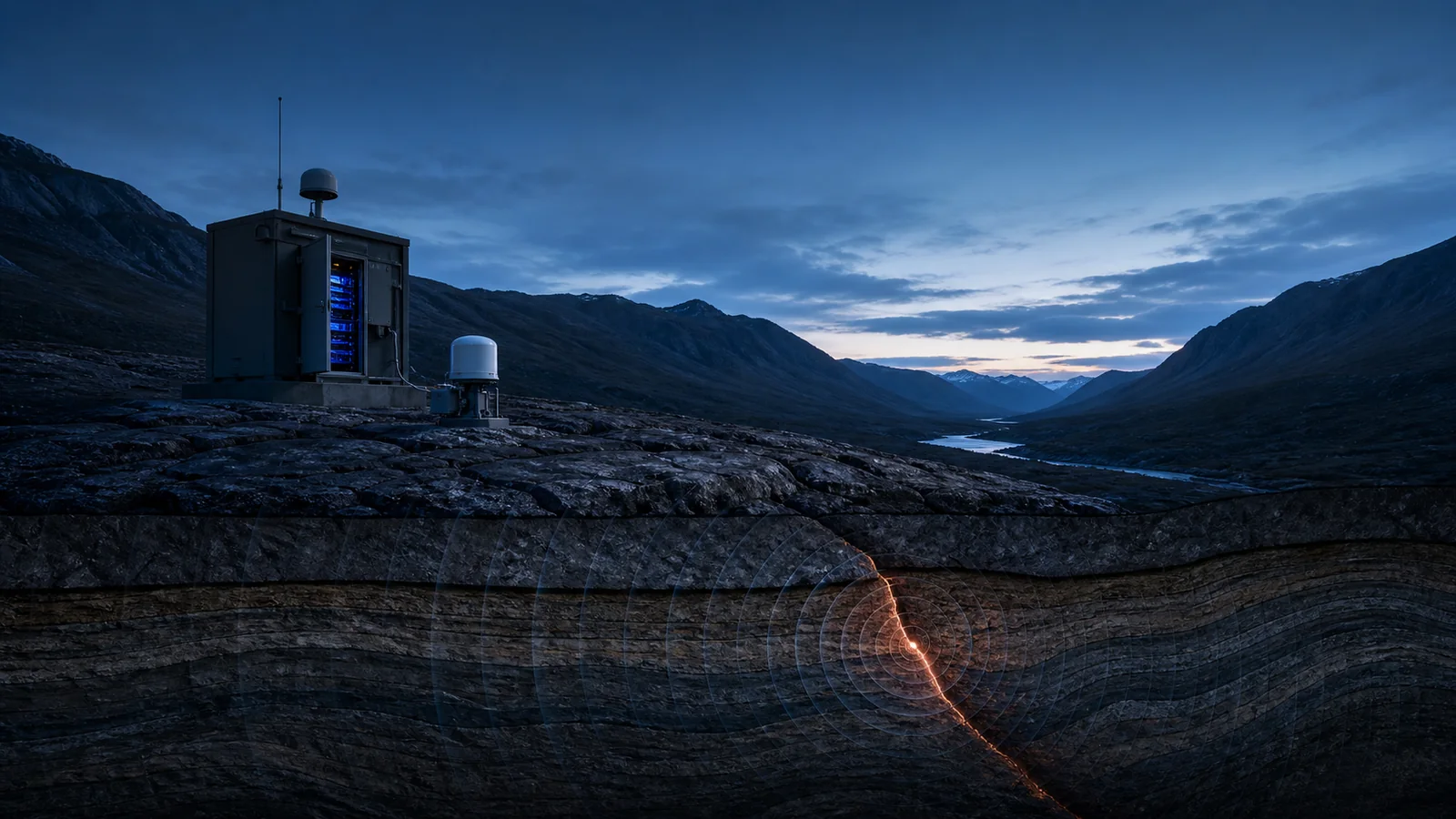
Scientific editorial reconstruction. The subsurface cutaway and wave fronts explain the measurement chain; they are not an image of a specific earthquake.
A logarithmic measure of earthquake size
Earthquake magnitude describes the size of a seismic event from instrument measurements. Each whole-number increase represents a tenfold increase in measured wave amplitude and roughly 32 times more released energy. Modern reports commonly use moment magnitude, while other scales may be appropriate for specific signal ranges or distances.
Magnitude is not intensity
Magnitude is one value for the earthquake. Intensity describes the shaking and effects experienced at a particular place, so it can vary across the affected region.
Depth, distance and local ground change the experience
A shallow earthquake close to a community can produce stronger local shaking than a deeper or more distant event of similar magnitude. Soil, rock, building design and rupture direction also influence effects. Magnitude alone does not predict damage, casualties, tsunami generation or the conditions at a specific address.
Common scales
Moment magnitude estimates total seismic moment and is broadly useful across event sizes. Local magnitude—the original “Richter” approach—remains useful in some regional networks. Body-wave and surface-wave magnitudes measure different parts of the signal and can saturate for large earthquakes.
From evidence to the PlanetVexa view
Each stage changes what can be claimed. PlanetVexa keeps the source record, derived interpretation and visual presentation visibly distinct.
- 01Ground motion
Seismometers record motion through time at individual stations.
- 02Network solution
Arrival times and amplitudes from multiple stations constrain origin, location and depth.
- 03Magnitude estimate
A stated magnitude method converts calibrated waveform or moment information into a source-size estimate.
- 04PlanetVexa record
USGS magnitude type, value, depth, time, revision status and source link remain together.
How to read a PlanetVexa earthquake record
Start with magnitude type and source update time, then read depth and location as estimates that can be revised. A small change between early and reviewed values is normal network processing, not evidence that the physical event changed.
Use the interactive earthquake map to separate overlapping events and compare time, depth and magnitude. Marker size aids selection; it is not a shaking-footprint or damage estimate.
Recent Earthquakes
Live records refresh independently from this article. Source time and freshness never change the editorial “Last updated” date above.
Source: USGS Earthquake Hazards Program · Freshness: Fresh · Live data updated · source details
Explore Live EarthquakesUse source time, definitions and official guidance
PlanetVexa explains and normalizes source-backed information for general understanding. Values can be revised, observations can be incomplete, and a global or statistical measure cannot replace local analysis or official safety guidance.
FAQ
Is magnitude the same everywhere?
Yes. An earthquake has one reported magnitude estimate, while experienced intensity varies by location.
Does one magnitude unit mean ten times more energy?
No. It means ten times the measured wave amplitude and approximately 32 times the released energy.
Read the official material
Definitions and operational context are checked against the responsible institutions. External material can be revised independently of PlanetVexa.